How Google Cloud Is Powering the Future of AI, Data, and Business Infrastructure?
Introduction & History
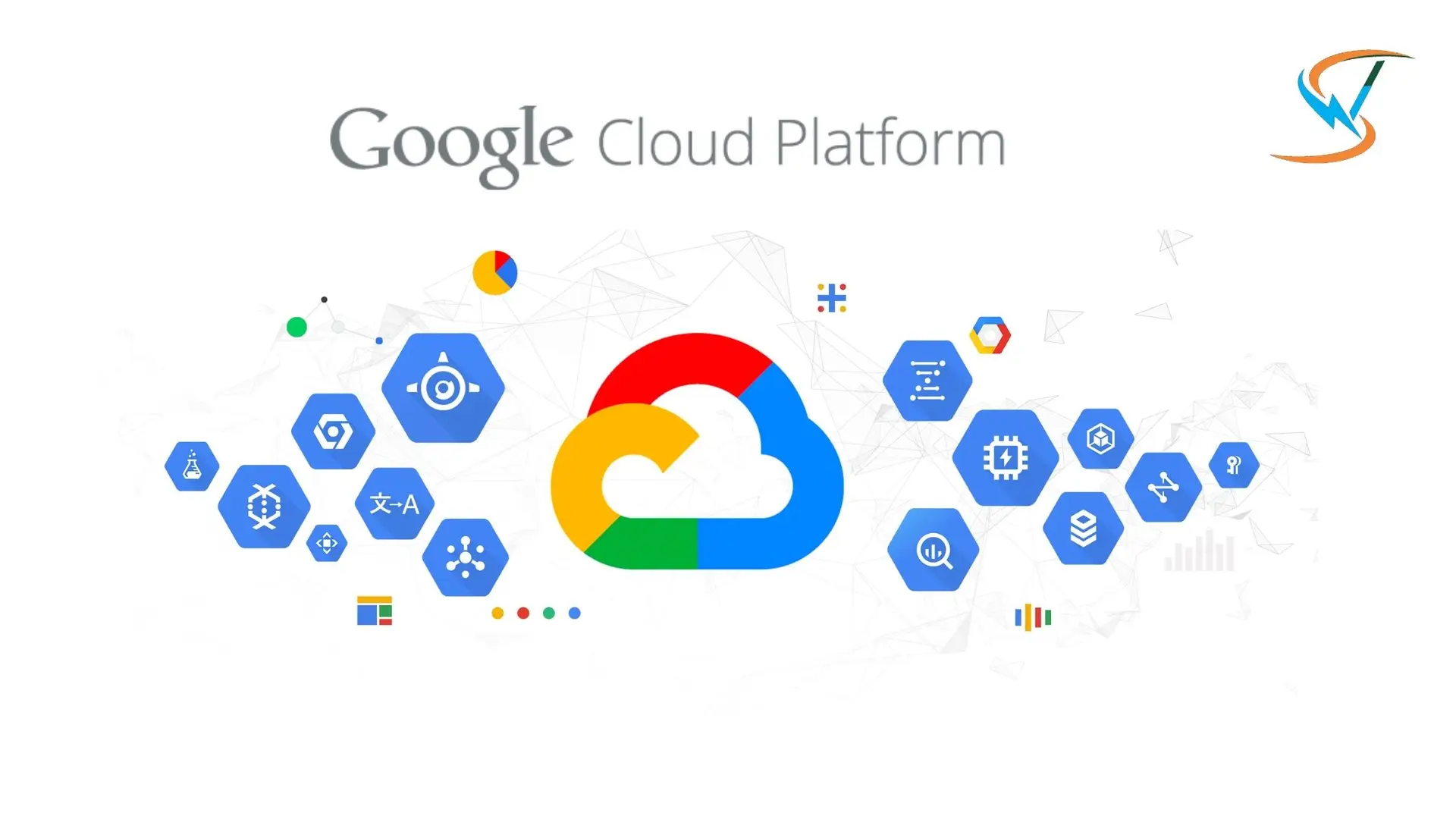
Google Cloud (often still called Google Cloud Platform, GCP) is Google’s suite of public cloud services, providing infrastructure, platform, and many higher-level services.
GCP allows users — developers, enterprises, startups — to build, deploy, and operate applications and services on Google’s infrastructure.
It includes services for computing (virtual machines, containers, serverless), storage, networking, big data analytics, machine learning / AI, security, identity, developer tools, and more.
GCP was launched in 2008, initially with Google App Engine, and over time expanded into a full suite of cloud offerings.
It uses the same underlying infrastructure that powers Google’s services like Search, Gmail, YouTube, etc.

Our digital transformation journey wouldn’t have been possible without Google Cloud. From Cloud SQL to AI APIs, everything integrates beautifully. The insights we gain from data analytics now directly influence strategic decisions
Anita Verma
Managing Director, Solution ERP’s
Core Concepts & Architecture
To understand Google Cloud’s offerings, it helps to know its architectural principles and organizational structure.
Regions
Geographically distinct locations (for example, “US-Central,” “Asia-SouthEast,” etc.). Users choose in which region to host their resources.
Zones
Subdivisions within regions (often multiple zones per region). Deploying across multiple zones helps with redundancy and high availability.
Global / Regional / Zonal resources
Some resources are global (e.g. images, snapshots), others regional or zonal depending on scope.
This layered infrastructure helps with latency, fault tolerance, and compliance (e.g. data localization).
Infrastructure as a Service (IaaS)
E.g. Compute Engine (virtual machines) where users control OS, runtime, etc.
Platform as a Service (PaaS)
E.g. App Engine, where Google abstracts much of the underlying infrastructure.
Serverless / managed services
E.g. Cloud Functions, BigQuery, managed databases — you don’t manage servers directly.
This allows users to pick the right tradeoff between control, convenience, and operational burden.
Virtual Private Cloud (VPC)
Isolated networks within Google Cloud that you define and control (IP ranges, subnets, firewalls, routes).
Hybrid & Multicloud Connectivity
With Cloud VPN, interconnects, peering, and more, you can connect your on-prem systems or other clouds.
Load balancing, CDN, and edge services
to distribute traffic and reduce latency.
Major Services & Products
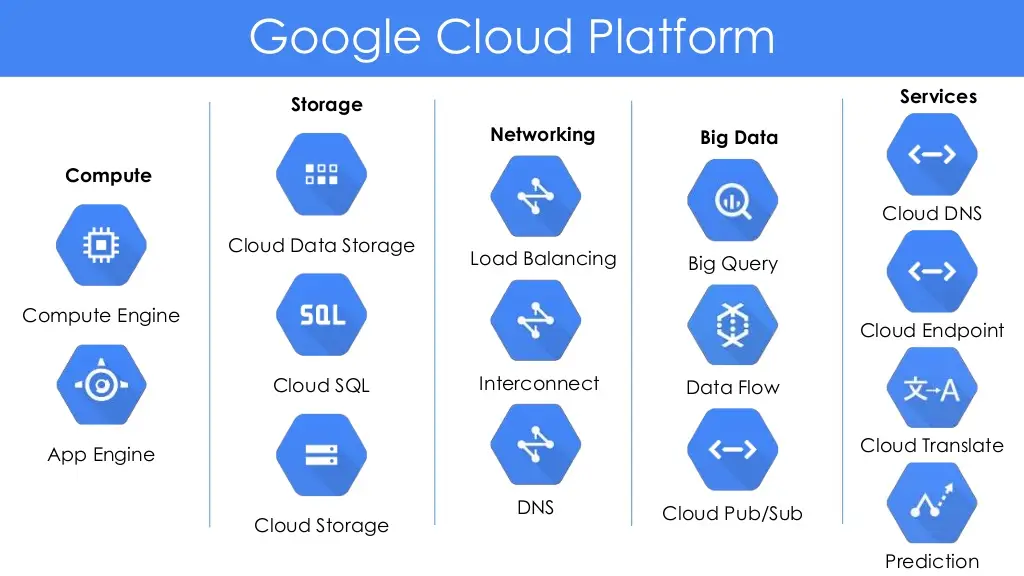
Below is an expanded look at key service categories and notable offerings in Google Cloud.
Compute Engine
virtual machines (IaaS) with flexible configurations.
Kubernetes Engine (GKE)
managed Kubernetes for container orchestration.
App Engine
fully managed PaaS for deploying web apps.
Cloud Functions / Cloud Run
serverless compute.
Cloud Storage
object storage for unstructured data.
Cloud SQL
managed relational databases (MySQL, PostgreSQL, SQL Server).
Cloud Bigtable
NoSQL wide-column database, high throughput.
Cloud Spanner
globally distributed relational database.
Cloud Datastore / Firestore
serverless NoSQL document databases.
BigQuery
fully managed, serverless data warehouse supporting SQL queries at scale.
Dataflow
stream and batch data processing.
Dataproc
managed Spark, Hadoop, and other cluster workloads.
Pub/Sub
messaging / event ingestion.
Vertex AI
unified AI platform for training, deploying, and managing ML models.
Prebuilt APIs
e.g. Vision API, Speech-to-Text, Translation API, Natural Language API.
TPUs / AI hardware
specialized hardware accelerators for AI workloads (TPU v4 etc.).
AutoML
low-code / no-code ML model training.
Identity and Access Management (IAM)
fine-grained permission control over resources.
Cloud Identity / Google Workspace integration
user / identity management.
Security Command Center, VPC Service Controls, Cloud Armor
security, policy, and protection services.
Formerly under “Stackdriver” suite
Cloud Monitoring, Cloud Logging, Cloud Trace, Cloud
Debugger, Cloud Profiler
tools to monitor, trace, log, and debug applications.
Cloud Audit Logging
maintains audit trails.
Cloud Build, Cloud Source Repositories, Cloud Scheduler etc.
Cloud Endpoints
API management, security, monitoring for APIs.
Apigee
full API platform.
Workflows, Cloud Tasks etc.
Each service often integrates with others, enabling end-to-end pipelines (e.g. ingest data via Pub/Sub → process via Dataflow → store in BigQuery → build ML model and serve with Vertex AI).
Strengths & Benefits
Strong data, analytics & ML capabilities
Google has long experience in large scale data processing and ML, so its offerings in BigQuery, Dataflow, Vertex AI, TPUs, etc. are mature and powerful.
Scalability & performance
The underlying infrastructure is the same as Google’s own systems, giving you access to significant scale with relatively low latency.
Flexible pricing & discounts
Many services use pay-as-you-go billing; Compute Engine offers sustained-use discounts (i.e. running machines for a good fraction of a month reduces cost).
Global infrastructure & availability
You can deploy in many regions and zones, enabling redundancy, disaster recovery, and compliance with locality requirements.
Open architectures & hybrid/multicloud support
Google tends to support open standards (e.g., Kubernetes, open APIs) and supports hybrid or multi-cloud models rather than “lock you in.”
Security & compliance
Google invests heavily in security and offers many compliance certifications, encryption options, identity controls, etc.
Integration & ecosystem
Integration with Google’s other products (e.g. BigQuery with AI services, data pipelines, APIs) can simplify comprehensive solutions.
Challenges & Considerations / Limitations
No platform is perfect, and Google Cloud has its drawbacks or things to watch out for
Learning curve & complexity
With so many services and options, selecting the right architecture can be challenging.
Cost management
Without careful monitoring, usage can balloon costs. (E.g. data egress, high compute usage, unused instances.)
Ecosystem maturity in some regions
In certain countries or regions, Google Cloud’s infrastructure (data centers, network coverage) may lag compared to competitors, affecting latency or compliance.
Service outages or risk
Like any large cloud, outages can and do occur. For example, Google Cloud faced a major outage in June 2025 affecting Spotify, Discord, Google Meet, etc.
Vendor competition & positioning
Competing with AWS and Azure, Google sometimes plays catch-up in features or enterprise adoption.
Use Cases & Real-World Applications
One recent major business deal: Meta (Facebook’s parent) signed a cloud deal with Google Cloud worth over $10 billion to use Google’s servers, storage, networking, etc.
Recent Trends & Business Developments
These moves suggest Google is leaning heavily into enterprise contracts (especially AI/ML infrastructure) while managing risks and local regulatory demands.
In 2025, Meta signed a huge multi-year agreement with Google Cloud, signaling growing enterprise trust in Google’s infrastructure.

Google has also faced some internal layoffs within its cloud division, particularly in UX research roles, even as cloud demand grows.


Best Practices & Tips
Here are some recommended practices when using Google Cloud
AI & Generative Models
Integration of large language models, generative AI, tools for inference at scale will be a key competitive area.
Custom hardware & acceleration
Google will likely continue advancing its TPU / custom chip lineups to offer better performance per watt and cost.
Hybrid / Edge / Distributed cloud
More capabilities to distribute workloads to edge locations, “on-prem plus cloud” solutions, or localized “sovereign clouds.”
Green / sustainable infrastructure
Given global attention on energy consumption, cloud providers are under pressure to optimize energy usage, cooling, and emissions.
Tighter integration across Google’s ecosystem
Deeper connections with Google’s consumer and enterprise products (Maps, Workspace, Android, etc.) to provide seamless full-stack solutions.